The Forested North: Wood, Cold, and Durability
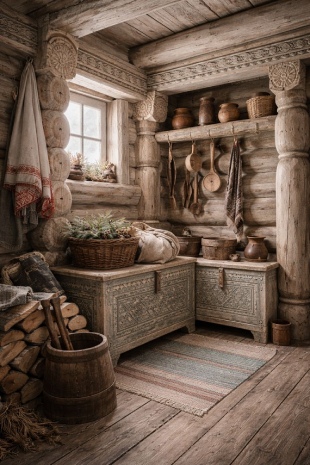
In northern regions, long winters and persistent humidity shape daily life and the objects people rely on. Technical choices tend to favor solidity, protection, and longevity. Wood becomes both a primary material and a visual language, used not only because it is abundant, but because it responds well to the demands of climate and construction.
There is also a strong focus on volume and assembly. When materials are difficult or costly to transport, value is placed on what is locally available and repairable. This context encourages objects built to last, with decoration that follows structure rather than conceals it.
Architecture and Carving: When Objects Must Endure
Woodworking traditions flourish where forests are close and buildings must withstand snow and frost. Carved forms are often integrated into load-bearing elements. They emphasize edges, joints, and corners, the places where wear appears first and where structure needs reinforcement.
The same logic applies to domestic objects. Chests, utensils, frames, and tools repeat motifs that visually strengthen their construction. Decoration guides the eye and makes the object’s assembly legible, reinforcing an understanding of how it is made and used.
Measured Palettes and Light-Sensitive Contrast
Where light varies sharply across seasons, contrast becomes a functional choice. Restrained colors better tolerate soot, dirt, and repeated handling. They also highlight the grain and texture of wood, which remains central to the regional style.
This restraint does not imply a lack of invention. Creativity appears in rhythm, repetition, and borders. A modest motif, repeated with precision, can create a strong presence without relying on a wide range of colors.
Protective Decoration and Seasonal Use
Those places where the residence works as an office at all times and as a haven of leisure, most of all, design treats thresholds most of all. When it is the ledge of the shelf, a frame, or an edge, there are badges showing where the territory ends. And sometimes in the form of magic creatures but rather as a way of arranging there where it processes space thus indicating change.
Sometimes it is necessary to decorate objects that are associated to seasonal work. This is clearly visible with the fairs, nuptials, hoeings, or even the fishing seasons as there will be colorful patterns. The change in is closely related to its purpose and is applied in respect to time and operational differences.
The Central Regions: Workshops, Markets, and Religious Imagery

In central areas, networks of towns and markets support the circulation of techniques and materials. The presence of workshops, sometimes specialized, encourages steady production of decorated objects. Styles often stabilize through repetition and collective learning rather than individual expression.
Proximity to religious centers also shapes visual culture. Artisans adapt compositional frameworks, color schemes, and conventions from sacred imagery to everyday objects. The result is not imitation, but translation, adjusted to different materials and domestic contexts.
Painted Household Objects: From Storage to the Table
Everyday objects offer ideal surfaces for painting. Trays, boxes, containers, and furniture elements become supports for decoration, especially in homes with few purely ornamental items. What is useful is what is seen most often, and therefore what is decorated.
Painted motifs are usually legible from a distance. Stylized flowers, vines, birds, and geometric forms fill space without overcrowding it. The drawing accommodates quick gestures and the practical need to repaint, repair, or refresh surfaces over time.
Iconographic Influence Without Confusing Sacred and Domestic
Icon traditions leave traces in how images are organized. Framing devices, defined backgrounds, strong outlines, and frontal compositions appear even when subjects are purely decorative. The structure of religious imagery informs the way space is arranged.
This influence also affects surface hierarchy. One main face receives denser decoration, while sides remain simpler. This reflects how objects are displayed, stored, or presented, and aligns visual emphasis with practical orientation.
Workshops, Apprenticeship, and Recognizable Hands
Workshops encourage coherent styles transmitted through practice. Apprentices learn a set of gestures and motifs, then gradually introduce variations. Over time, recognizable “hands” or family techniques emerge without becoming rigid formulas.
Contact between workshops produces hybrid forms. A motif changes shape as it moves between villages. Colors shift according to available pigments. Regional style becomes a continuum with accepted deviations rather than a fixed template.
The Volga Region: A Corridor of Contact and Coexistence
Along the Volga River, exchange has long been intense and layered. Traditions intersect without fully merging. Instead of a single dominant style, there is often a coexistence of aesthetic priorities shaped by proximity and interaction.
- Geometric and floral motifs circulating between textiles, wood, and leather
- Emphasis on borders and decorative bands that adapt easily across materials
- Colors derived from local dyes, with variation depending on resources
- Ornaments linked to festivals and family status, visible on clothing and gift objects
- Braiding, embroidery, and appliqué techniques designed to withstand wear and washing
- Decorative systems that signal belonging while remaining open to borrowing
This diversity is reinforced by mobility. As families move or trade, they carry objects, fabrics, and dye recipes. Style becomes a shared set of solutions, adjusted to local contexts and shaped by memory and contact.
The South: Expressive Textiles and Agricultural Symbolism
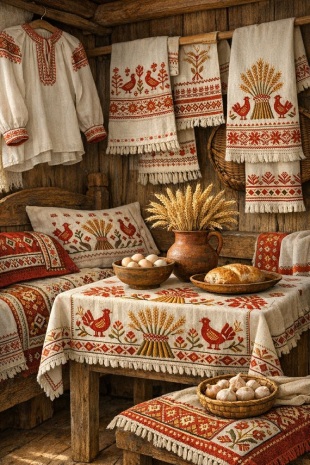
The people inhabiting the warmer climes of the earth, or the south, textile products like fabric takes the center stage due to the availability of the fibers and the lifestyle of these people. Here, clothes, fabrics used indoors, and even bedclothes play a very important part while being rich in ornamental elements. People - their clothes are designed to last and be even more ajdorned. In the south, unlike perhaps in the north, there is a great deal of sunshine which, because of the cultivable lands, vegetation, dry conditions etc, makes it difficult, if not problematic.
Embroidery and Stitching as Surface Writing
Embroidery functions as a form of writing applied to cloth. It strengthens edges, emphasizes openings, and stabilizes stress points. This is particularly practical for garments and linens that are washed or worn repeatedly.
Motifs are often built from modules. Simple forms repeat and combine to create bands or panels. This modular approach aids transmission, as learners master units before composing larger patterns.
Color and Contrast Shaped by Resources and Function
Color choices depend on available dyes and the visual role of the object. Ceremonial pieces may seek impact, while everyday linens favor colors that endure. The palette is therefore technical as well as aesthetic.
Contrast clarifies pattern. On fabric, a weak line disappears with wear. Strongly placed colors preserve legibility even after years of use.
Agricultural Symbols and Domestic Imagery
Themes tied to fertility, seasonal cycles, and the household appear in stylized form. Plants, birds, sheaf-like shapes, and branching forms create a visual language of wishes rather than fixed narratives.
Meaning adapts to context. On a dowry piece, a motif may suggest abundance. On a work apron, the same form becomes a practical rhythm that holds its place on the surface.
The Urals and Siberia: Local Materials and Moving Traditions
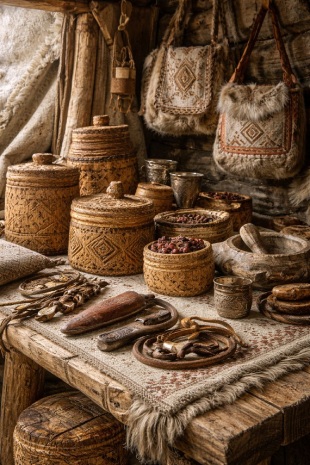
In the Urals and Siberia, distance and environmental diversity challenge the idea of a single region. Available resources change quickly. Wood, bark, fur, metal, and stone may all become central depending on location. Styles adapt to what is at hand and what can travel.
Contact between populations, both longstanding and recent, leaves visible traces. Borrowing and coexistence are common. Style is less a clear boundary than a set of practical choices that nonetheless express local identity.
Bark, Hide, Felt, and Metal: Material Dictates Form
Certain materials impose specific construction methods. Bark bends and weaves. Felt is cut and layered. Metal allows engraving and repoussé. Each technique generates motifs suited to its constraints.
This dependence on material creates recognizable styles. The same geometric motif reads differently when carved, stitched, or applied. Environment shapes gestures as much as subjects.
Portable Objects and Forms Suited to Movement
Where mobility is part of life, objects must be transportable. Foldable, stackable, and durable formats are favored. Decoration follows suit, emphasizing motifs that resist abrasion and remain legible on curved or flexible surfaces.
Even in more settled contexts, isolation often requires repair rather than replacement. Objects accumulate traces of use, and repairs become an additional visual layer, recording history through material change.
Exchange With Indigenous Traditions and Border Logic
In several areas, indigenous traditions contribute techniques and motifs distinct from those of western regions. Decorative systems may emphasize geometry, repetition, or animal relationships differently. These should be read as complete traditions rather than secondary influences.
Border zones also foster hybrid objects. An artisan may apply a local technique to an external form. Regional style becomes an ongoing negotiation between continuity and adaptation.
Continuity Through Variation, Not a Single Model
If there is unity in Russian folk art, it lies in use. Painting, carving, and embroidery rarely exist only for visual pleasure. They reinforce objects, mark status, organize domestic space, and transmit making habits.
From this perspective, regional diversity is not a collection of curiosities. It shows how a shared material culture adapts to different conditions. Styles change because lives change, yet they retain logics of transmission that link generations.
Reading Regional Styles Through Use and Transmission
When considering the customs of a certain area, the attention should also be paid to the way in which knowledge has been passed throughout generations. Generally speaking, not so much learning process was based on written instruction, but rather practical work and traditions of the people. Children observed adults’ creation and mending of items and learnt the details of sizes, proportions, and procedures such as working with pottery wheel. It definitely secures how information is passed however it, with the passage of time fewer adjustments in the overall pattern occur. Because variations might occur within the same society i.e. one motif might change a little in the process because of a new tool, or an old one is dropped and another is adopted.
Diversity as a Cultural Strength
Regional artistic traditions across Russia reveal a culture shaped by adaptation rather than uniformity. Materials, climate, movement, and social structure all influence how objects are made and decorated. What persists is a practical approach to beauty, where form, function, and meaning remain closely connected. This diversity does not fragment the tradition. It strengthens it by allowing continuity through change.
With the kind support: