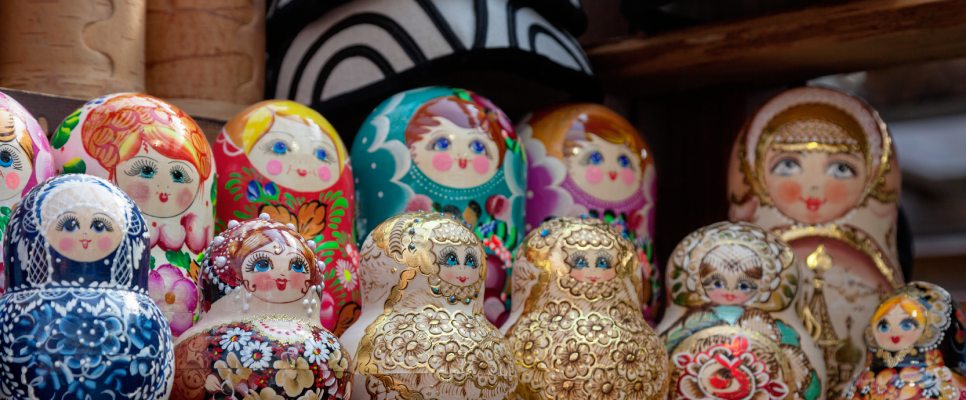
How Matryoshka Dolls Emerged In Late-19th-Century Russia
The most popular rendition of the story places its root into one creative instant in the 1890s at a colony in Abramtsevo, situated near Moscow, where a mixture of industrialists and intellectuals taking a summer holiday accidentally encountered one another. There, a turner, Vasily Zvyozdochkin, prepared the prototype of a doll; it was then designed by the painter Sergey Malyutin to immortalize the image of a rosy-cheeked peasant girl with a black rooster. That very first doll was nested among seven other dolls and turned out to be a Russian Matryoshka.
Malyutin's design was reportedly inspired by a Japanese nesting figure called Fukurama, a bald-headed sage whose hollow wooden body contained a series of smaller figures. The Russian artists did not simply copy it. They reinterpreted the concept through their own visual culture, producing something distinctly Slavic in character and feeling.
From Folk Craft To National Symbol
Within a decade of the first Matryoshka being carved at Sergiev Posad in the 1890s, the doll had already outgrown its workshop origins. The 1900 Exposition Universelle in Paris gave Russian handicrafts a global stage, and the Matryoshka won a bronze medal there, drawing attention from collectors and cultural observers across Europe. That moment accelerated something already quietly underway at home.
Russian intellectuals and artists of the late 19th century were actively searching for symbols of authentic national identity, something rooted in peasant life and untouched by Western influence. The Matryoshka fit that need almost too neatly. Painted in bright folk motifs and shaped like a round, rosy peasant woman, it looked ancient even though it wasn't.
Historians sometimes call this an "invented tradition," a modern creation dressed in the clothing of deep-rooted custom. The Matryoshka was born in a Abramtsevo art colony workshop, inspired partly by a Japanese nesting doll. Yet by the early 20th century, it was already being sold as an expression of timeless Russian rural life. There's no denying how effectively that story stuck.
What The Nested Form Came To Represent
Generations of Russian families saw something deeply familiar in the nesting structure: a mother containing smaller versions of herself, each one distinct yet inseparable from the whole. The most common reading ties the form to motherhood and generational continuity, the idea that identity is passed down rather than invented. A woman holds a woman holds a woman - the repetition itself carries meaning.
Family unity is another reading that stuck. The dolls fit together by design, which made them easy shorthand for belonging and interdependence. Some might argue this symbolism was always partly constructed, a projection rather than an original intent, but it resonated widely enough to become conventional.
We would rather say that the painted interpretations traveled far indeed from the original theme of the peasant woman; and the sets from the Soviet era would span Communist leaders, i.e., Lenin, Stalin, and Gorbachev, displayed in an almost satirical order. Some would be portraying Literary sets. There was nothing too profane or unholy in contact with religious motifs. The links emerged from the unutterable logic of nesting, each project carrying an entirely different culture type if emphasis itself-reverence, critique, or commemoration. The container, as was eventually discovered, actually had an element of ideological neutrality, whereas the contents never did.
Why These Dolls Still Matter Across Cultures
Invented in 1890, the Matryoshka won a bronze medal at the Paris Exposition Universelle of 1900. This is an object quite young for its very heavy cultural load. However, the permanence of it is remarkable: it has nothing to do with any antiquity and everything to do with a craft, a national identity, commerce and, ultimately, that one great idea--a thing inside another thing, or a surface covering a depth. This metaphor still travels extremely well. It is borrowed by artists, political cartoonists, and philosophers as if it were theirs to decide. For example, the doll conceives itself most comfortably in a museum's permanent collection and in an airport's gift shop, and this is quite telling in itself. It remains an iconographic representation of Russia to everyone across different cultures which may show little else in common. As a broader metaphor for layered identity: personal, national, psychological-it has outlasted the nationalist moment which birthed it and now keeps on evolving to new meanings with the changing ages of new arrivals who pick it up and inspect it.
With the kind support: